
1939 Buick Special Sport Coupe
Bonhams
Darien, CT 06820Manual
Be first if it's relisted or another Buick Special comes up
We'll search 100+ marketplaces, auctions and forums, plus thousands of dealers, and notify you when we find one. Seen across 9 sites in the last 30 days.
or
Free. Unsubscribe anytime. By continuing, you agree to our Terms and Privacy Policy.
Summary
From Bonhams
1939 Buick Special Sport Coupe Chassis no. 23492506 Body style 46S Body no. C-894 Long famous for straight eight engines, Buick didn't enter the field until 1931, by which time almost everyone else in the business had one.
More details
Although late to the game, Buick was certainly a strong contender, for it offered not one eight, not two, but three. Despite their use of similar architecture, including Buick's hallmark Valve-in-Head design, they had almost no interchangeable parts. This was soon recognized as the extravagance that it was, and Buick soon settled down to two different engines for its four series of cars.
In 1936, Buick added series names to its numerical designations. Thus the entry-level Series 40 became the Special, although the numbered series persisted into the 1950s. For 1938, cars were given coil spring rear suspension.
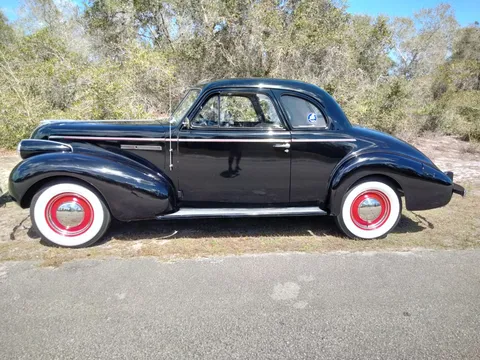
A live axle setup, it used a torque tube and radius rods. In 1939, Buick pioneered factory-installed directional signals, though on the rear only. An older restoration, this 1939 Buick Sport Coupe presents very nicely in medium metallic blue.
The paint exhibits a good shine, and the body contours are straight and true. The car has wide whitewall tires and accessory trim rings; amber foglights are mounted on the front bumper. The interior is upholstered in blue/gray cloth, nicely contrasting with the dark woodgrain dashboard and window moldings.
The car has a nice example of Buick's hard-to-find red phenolic steering wheel. These were prone to cracking early in life, and unblemished wheels are particularly prized. The rear of the passenger compartment is furnished with "opera seats," that fold-down from the side panels.
The whole of the interior is unworn and unblemished. The engine compartment is correctly restored, painted and detailed, although it shows some signs of use. The "Dynaflash 8" engine runs well, and the car drives easily.
The undercarriage is clean and painted in black flat-finish paint. One of the most attractive Buicks of its era, it is sure to please a new owner.
—
Loading sold figures · 12 months to Sep 12, '10
Listing history
1 appearance- 9/12/2010BonhamsUnsold· this listing—
Similar cars for sale




© 2026 Hypercars Technologies Inc. All rights reserved.
Hypercars Technologies Inc. is not affiliated with the companies or individuals mentioned on its site. Third-party trademarks and logos belong to their respective owners; use does not imply endorsement or affiliation. Data is provided "as is" without warranty of accuracy, completeness, or timeliness.