
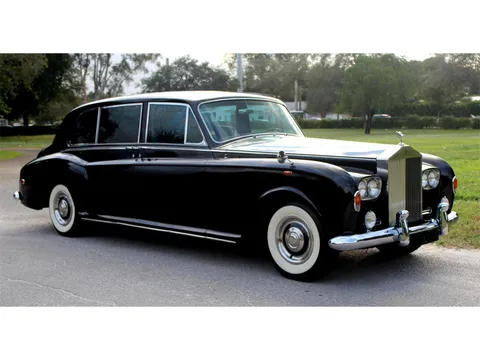
1970 Rolls-Royce Phantom VI
RM Sotheby's
Auburn, IndianaAutomatic
Get the next Rolls-Royce Phantom VI first
We'll search 100+ marketplaces, auctions and forums, plus thousands of dealers, and notify you when we find one. 7 listed in the past year. The last was 9 days ago.
or
Free. Unsubscribe anytime. By continuing, you agree to our Terms and Privacy Policy.
Summary
From RM Sotheby's
The Phantom name is symbolic of Rolls-Royce elegance as the successor to the legendary Silver Ghost, dating back to 1925 when it was first made available on the market. The Phantom readily met its intended customer’s high expectations of brilliance. It was an excellent car of unchallenged quality that continued the traditions of Rolls-Royce and presented the name that would ultimately move the company into a new century.
More details
Moving forward, in 1959 Rolls-Royce introduced a new Phantom model that was designated the Phantom V; it was a substantially more modern car than its predecessor and with so few produced at such a high price tag, the Rolls-Royce Phantoms of 1959 to 1991 were made for a very special type of client. Figureheads, leaders and celebrity became the established clientele that includes; almost obviously, the Queen of England, Queen Elizabeth II, as well as her mother. Among the others was the governor of Hong Kong for ceremonial purposes and the King of Norway employed his limousine as an official car.
Perhaps, most famously, Beatle John Lennon bought a brand new Phantom V in 1965 and had many modifications that included a radio telephone, converting the rear seat into a double bed, an interior/exterior “hailer” sound system, Sony television and portable refrigerator. Expected extravagances of the famed musician; it is reported that John had his chauffeur and car sent over to Spain in 1966, while he was filming "How I Won the War". The Phantom V ended up in a matte black overall presentation that amazingly included the radiator and chrome trim.
Lennon reportedly tired of the “stealth” Phantom, so he took it upon himself to visit J. P. Fallon Limited, a coachworks company located in Chertsey, Surrey having thought he would like to have his car painted "psychedelic".
While hailed in some quarters and drawing praise for artistic expression, from others it drew public outrage as Rolls-Royce is passionately regarded in England as one of the many symbols of British dignity. The owners of the Phantom VI were no less remarkable. Rolls-Royce understood the kind of customer base it had with the Phantom models, and offered an armored version of the Phantom VI for higher profile buyers that wanted added protection.
The Phantom VI, unveiled in 1968, was heir to the throne of the first Phantom, which made its debut more than 40 years earlier and likewise represented the ultimate in coachbuilt luxury, again reserved for wealthy clients, royalty and the like. Most of the Phantom VIs produced – just 374 cars over the vehicle’s 24 year run – were fitted with custom, handcrafted bodies at the Mulliner Park Ward coachbuilding factory at Hythe Road, Willesden, London. They built Phantom VI bodies slowly and painstakingly as traditional artisans in elegant, stately style.
In the eyes of many enthusiasts, with the end of Phantom VI production in 1991, it symbolized the farewell to tradition. It was an openly noble mark of the automotive industry's most refined company. When the last two Phantoms were produced in 1990, so ended the last truly coachbuilt motorcar.
It was the last body fashioned by Mulliner Park Ward before the 100-year-old coachbuilder officially came under the Rolls-Royce umbrella.
—
Loading sold figures · 12 months to May 11, '14
Listing history
1 appearance- 5/11/2014RM Sotheby'sSold· this listing$109k
Sold for
$109k
#2 of Phantom VIs in 2014
Top 10% of all listings in 2014
Similar cars for sale


© 2026 Hypercars Technologies Inc. All rights reserved.
Hypercars Technologies Inc. is not affiliated with the companies or individuals mentioned on its site. Third-party trademarks and logos belong to their respective owners; use does not imply endorsement or affiliation. Data is provided "as is" without warranty of accuracy, completeness, or timeliness.