
1934 Rolls-Royce Phantom II Continental Sports Saloon
Bonhams
Westport, CT 06880Manual
Didn't sell. Hear first if it or another Rolls-Royce Phantom II is listed.
We'll email you each one as it's listed.
About 2 a week across 2 sites.
Free, one-click unsubscribe. By continuing, you agree to our Terms and Privacy Policy.
Summary
From Bonhams
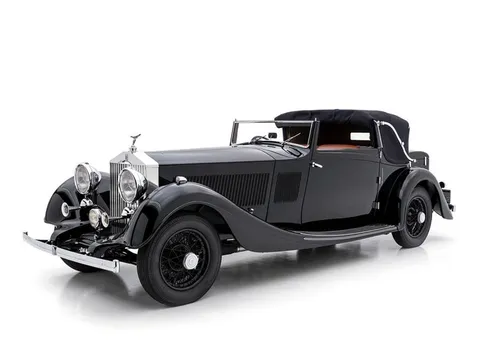
1934 Rolls-Royce Phantom II Continental Sports Saloon Coachwork by J. Gurney Nutting Chassis no. 109 SK Engine no.
More details
JE 25 Reputedly the last model Henry Royce designed himself the Phantom II was introduced in 1929 as a successor to the New Phantom. Following Royce's keen interest in a more sporting version, as evidenced from the Experimental Phantoms (see Lot 357) and designed around the short (144") Phantom II chassis a 'Continental' version arrived in 1930. As the name suggested it was conceived as 'an enthusiastic owner driver's car' intended for fast touring abroad, and featured revised rear suspension, higher axle ratio and lowered steering column.
Highly favored by prominent coachbuilders, the Phantom II chassis provided the platform for some of the truly outstanding designs of its day its new low-slung frame, enhanced engine performance and set back radiator lending itself well to coachbuilders art. By the end of production the magnificent Phantom II Continental was good for 95mph. "Powerful, docile, delightfully easy to control and a thoroughbred, it behaves in a manner which is difficult to convey without seeming to over-praise," opined The Motor after testing a PII Continental in March 1934.
The growing interest in closed and streamlined cars of the Thirties meant that the lion's share of coachwork on these chassis was devoted to sporting saloons, as fashion moved away from long open tourers of the 1920s. Arguably the smartest act, were the long established firm of Gurney Nutting, who with ace designers in house would pen some of the most elegant lines of all of their contemporaries, certainly in the U. K.
if not further afield. 109 SK is one such example, with its low windshield, trouser crease fenders and high waistline, it exemplifies the care that went into wind-cheating coachwork in this era. This car was originally delivered in the U.
K. new to Captain V. H.
Holt of York and it is understood that he traded his 6. 5 Liter Bentley against his purchase. It was guaranteed on December 22, 1934 and it would seem from a kicker plate that the car still wears that this transaction went through the noted garage The Car Mart of North London.
Three years later, a Major J. S. Struthers of Argyllshire became the next owner and it would remain in the U.
K. through three further ownerships into the early 1960s at which point it crossed the Atlantic passing to Alan McEwan of Washington. James Larcombe of Montana bought the car in 1966, from whom the previous Pacific Northwest owner would acquire the Continental and keep it for many years.
In an imposing scheme of light gray with a leather roof covering in darker gray, this contrasts well and the high body molding which runs from stem to stern is sensibly differentiated with a solid red coachline. Of particular note is the sporting dash, complete with large 120 mph gauge and matched clock, an unusual feature in any Rolls-Royce and very attractive one. Illustrated in Raymond Gentile's definitive work on the model, The Phantom II Continental , it is easy to see from this and other publications on the coachbuilt Rolls-Royce that there are cars and there are cars, some have it and some do not.
In our opinion this is the famed house of Gurney Nutting displaying what it did best, and mounted on the legendary Phantom II Continental chassis, it offers huge potential for a future concours winning car, if some of its details were played up a little more and arguably if presented in more subtle livery. That suggestion aside, the car is running and performing well and could easily provide a long legged driver quality automobile for road events such as those of the Rolls-Royce Owners Club.
—
Loading sold figures · 12 months to Sep 18, '11
Listing history
1 appearance- 9/18/2011BonhamsUnsold· this listing$149
Final bid
$149
Bottom 30% of Phantom IIs in 2011
Bottom 20% of all listings in 2011
Similar cars for sale



© 2026 Hypercars Technologies Inc. All rights reserved.
Hypercars Technologies Inc. is not affiliated with the companies or individuals mentioned on its site. Third-party trademarks and logos belong to their respective owners; use does not imply endorsement or affiliation. Data is provided "as is" without warranty of accuracy, completeness, or timeliness.