
Mazda RX-7 Buying Guide: FD, FC & FB Generations Compared
Summary
An RX-7 FD typically sells for $39K across 107 sales in our data, and a non-turbo FC $9,625. Mazda built the RX-7 from 1978 to 2002 in three generations, all rotary powered. The FD (1992-2002) is the pinnacle: a sequential twin-turbo 13B-REW, a celebrated design and near 50/50 weight distribution. It typically sells for $39K across 107 sales in our data, with the middle half of sales between $31K and $48K. The second-generation FC (1986-1991 in the US) is the affordable RX-7, at a median $9,625, and the FC Turbo II is the value play at $22K. The original SA and FB cars (1978-1985) typically sell for $14K. Every RX-7 buyer must understand rotary maintenance: apex seals, premix oil and rebuild cycles are part of ownership.
Rankings
- 1
 RX-7 FDMedian $39,000 12-mo +9.7%n=107 sold
The twin-turbo pinnacle: 255 hp in US form from a 1.3 liter rotary, in one of the best-looking sports car bodies of the 1990s
- 2
 RX-7 FCMedian $9,625 12-mo +29.4%n=50 sold
The second-generation RX-7, a capable and underrated chassis and the cheapest way into a rotary sports car
- 3
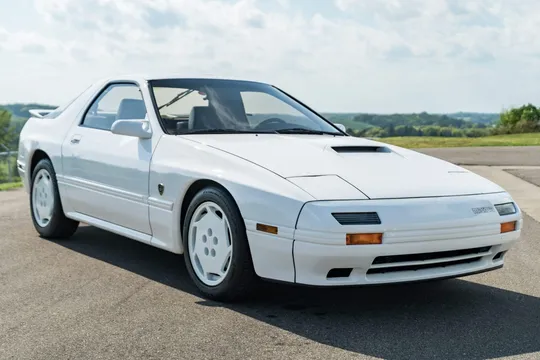 RX-7 FC Turbo IIMedian $22,250n=11 sold
The turbocharged FC with 182-200 hp, offering serious performance for much less than an FD
- 4
 RX-7 SA & FBMedian $13,775 12-mo -18.2%n=80 sold
The original lightweight rotary sports car (1978-1985) that started the line, pure and simple
Comparison
| Model | Median Price | Typical Range | Sales | 12-mo Trend | Avg Mileage |
|---|---|---|---|---|---|
| RX-7 FD | $39,000 | $31,302 – $48,300 | 107 | +9.7% | 56,628 |
| RX-7 FC | $9,625 | $8,100 – $15,771 | 50 | +29.4% | 71,106 |
| RX-7 FC Turbo II | $22,250 | $19,554 – $32,375 | 11 | — | 69,536 |
| RX-7 SA & FB | $13,775 | $9,678 – $18,215 | 80 | -18.2% | 60,906 |
How to Choose
- Compression testing is the most important pre-purchase step. Use a rotary-specific tester: readings well below 7.0 kg/cm2 on any face (normalized to 250 rpm), or more than 1.5 kg/cm2 between faces, point to a several-thousand-dollar rebuild.
- FD prices are set by originality. Stock, original cars sell at the top of the market and modified cars for much less.
- The FC Turbo II (1987-1991) typically sells for $22K, against $39K for an FD. The non-turbo FC is slower but the cheapest way into a rotary sports car at $9,625.
- The SA and FB are the simplest RX-7s to own: light, carbureted and mechanically easy. The 1984-1985 GSL-SE with the fuel-injected 13B is the one to look for.
- The FD was sold new in the US only for 1993-1995. Later JDM-only FDs, including 276 hp versions and the final 2002 Spirit R, are reaching 25 years old and entering the US. Verify import paperwork and title history carefully.
- Check FD cooling and vacuum systems. Overheating kills rotaries, and the sequential-turbo vacuum lines are a common source of boost problems.
- Never buy a heavily modified RX-7 unless you can verify the builder's reputation. Bad rotary builds fail catastrophically.
Frequently Asked Questions
- How much is a Mazda RX-7?
- It depends on the generation. In our data an FD typically sells for $39K, an FC Turbo II $22K, a non-turbo FC $9,625 and a first-generation SA or FB $14K. Condition and originality move FD prices more than mileage.
- How much is a Mazda RX-7 FD worth?
- FDs typically sell for $39K across 107 sales in our data, with the middle half of sales between $31K and $48K. Low-mile, unmodified examples in original colors sit at the top of that range. Modified cars sell for much less than stock equivalents, and automatics sell for far less than manuals.
- How much is an FC RX-7?
- A naturally aspirated FC typically sells for $9,625 across 50 sales in our data, and the FC Turbo II $22K. Convertibles and clean, original Turbo IIs are the most sought-after FCs.
- What years was the Mazda RX-7 made?
- 1978 to 2002. The first generation (SA and FB) ran from 1978 to 1985, the FC from 1986 to 1992, and the FD from 1992 to 2002. US sales of the FD ended after the 1995 model year, and Japan-market production ended with the 2002 Spirit R.
- How reliable is the RX-7 rotary engine?
- The rotary is reliable when maintained correctly but has a finite lifespan, and many need a rebuild somewhere around 80K-120K miles. Premix a little two-stroke oil in the fuel (commonly half an ounce to an ounce per gallon), never lug the engine at low RPM, and let the car warm up fully before driving hard.
- What kills a rotary engine?
- Low-RPM lugging (starves the apex seals of oil), inadequate warm-up, coolant leaks into the rotor housings, overheating and poor fuel quality. The rotary needs to spin to stay healthy. Short trips with no warm-up are the worst use case.
- RX-7 FD or Supra: which should I buy?
- The FD is lighter (about 2,800 lb against 3,400 lb for a Supra Turbo), more agile, and more exotic-feeling. The Supra is more robust, easier to modify to extreme power, and more comfortable. The FD rewards driving skill; the Supra rewards horsepower. Both are icons.
- Will Mazda make a new RX-7?
- Mazda has not announced one. Its 2023 Iconic SP concept used a two-rotor engine as a generator, and its 2025 Vision X-Coupe concept pairs a twin-rotor turbo engine with a plug-in hybrid system, but no production rotary sports car has been confirmed.
Methodology and sources
Based on 248 completed auction sales from the last 2 years on Bring a Trailer, Cars & Bids, eBay Motors, PCarMarket, Collecting Cars and other auctions. Fixed-price listings are left out, since they record an asking price. Prices are normalized to USD. Each price is the median sale, the way our valuations work, and typical ranges show the middle half of sales (25th–75th percentile). Stats update daily.
Related Guides
- Best JDM Cars of All Time: 18 Icons and What They Sell ForThe greatest Japanese domestic market cars ranked by cultural impact, driving experience, and real auction data
- Cars Turning 25 in 2026: Every Notable 2001 Model, With Real PricesEvery notable 2001 model year car now eligible for US import under the 25-year rule, with real pricing data
- Toyota Supra MK4 vs MK5: A80 vs GR Supra ComparisonComparing the legendary A80 Supra with the modern GR Supra by price, performance, tuning potential, and collectibility
- Honda S2000 Buying Guide: AP1 vs AP2 ComparedS2000 buyer's guide comparing AP1 and AP2 generations, the CR special, and what to pay
- Best Sports Cars Under $50K in 2026Top sports cars under $50,000 ranked by driving experience, value, and real auction data
- Best Japanese Cars to Modify in 2026Japanese performance cars ranked by mod potential, aftermarket support, and value